
What AI Cannot Replace: A Radiation Oncologist's Honest Answer
How AI-assisted radiation oncology could expand access, support rural physicians, and improve cancer care without replacing human judgment.

On AI, Oncology & Equity — A Physician’s Perspective on Smarter Care Without Losing the Human Context
I get asked a version of this question more often than any other right now:
“Is AI going to replace physicians?”
Sometimes it comes from medical students nervous about their career choice. Sometimes from colleagues watching automation move through radiology, pathology, and now oncology. Sometimes from patients who want to know whether the physician across from them is still the one making the decision.
I want to give a real answer. Not a reassuring answer designed to make everyone feel better. A real one — because I think physicians who pretend the question is ridiculous are not being honest, and physicians who catastrophize about obsolescence are not being accurate.
The truth, as I understand it from inside this field, is more nuanced and more interesting than either extreme.
AI In Radiation Oncology
What AI Does Well — and I Mean Really Well
Let me start by giving AI its due, because I think some of the defensiveness in medicine comes from a reluctance to acknowledge what the technology actually does. This has the potential to shape rural cancer care access.
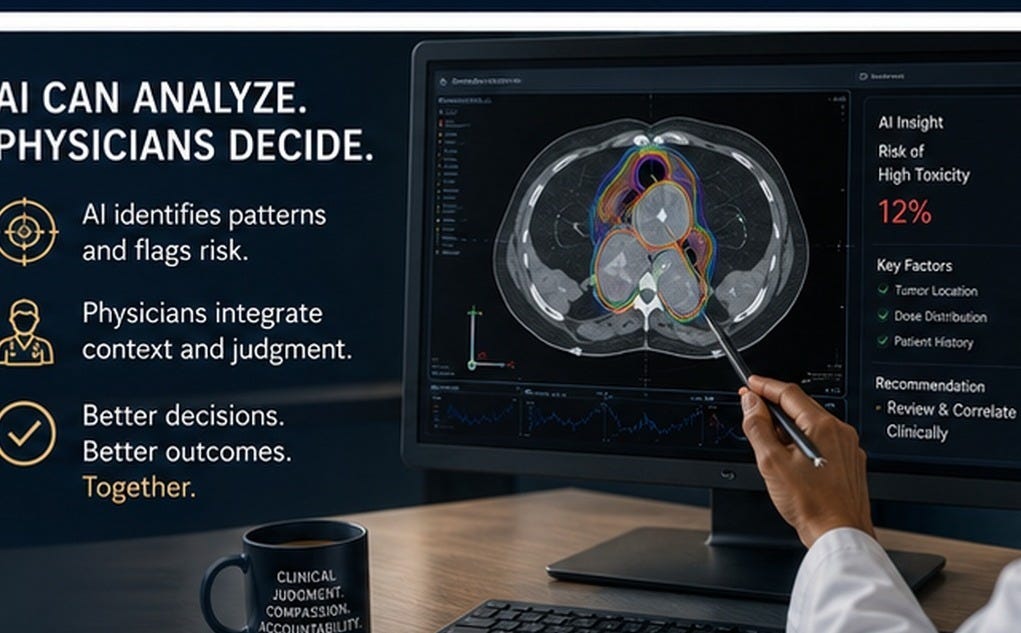
AI-assisted auto-contouring in radiation oncology can reduce contouring time from hours to minutes in many cases — while maintaining clinically acceptable accuracy with physician oversight - approaching expert-level performance for many standard organs-at-risk (OARs) and common disease sites. That is remarkable. I say that as someone who has spent hours at a contouring workstation. The time saved is real, and the clinical implications for patient throughput and physician capacity are significant.
AI can identify imaging patterns and radiomic features that may correlate with treatment response, recurrence risk, or toxicity—though many of these applications are still being validated for routine clinical use.
AI can flag dosimetric anomalies in treatment plans before they reach the patient. In some health systems, AI models can help predict which patients are at risk of missing appointments. It can translate a clinical summary into a patient’s language in real time. AI-assisted workflows have the potential to shorten prior authorization timelines.
Most of these tools function within a ‘human-in-the-loop’ model, where physician oversight remains essential for validation and final decision-making.
These are not small things. These are capabilities that, deployed well, will improve the quality, safety, and reach of cancer care.
I believe that. I want to be on record believing that.
And Here Is What It Cannot Do
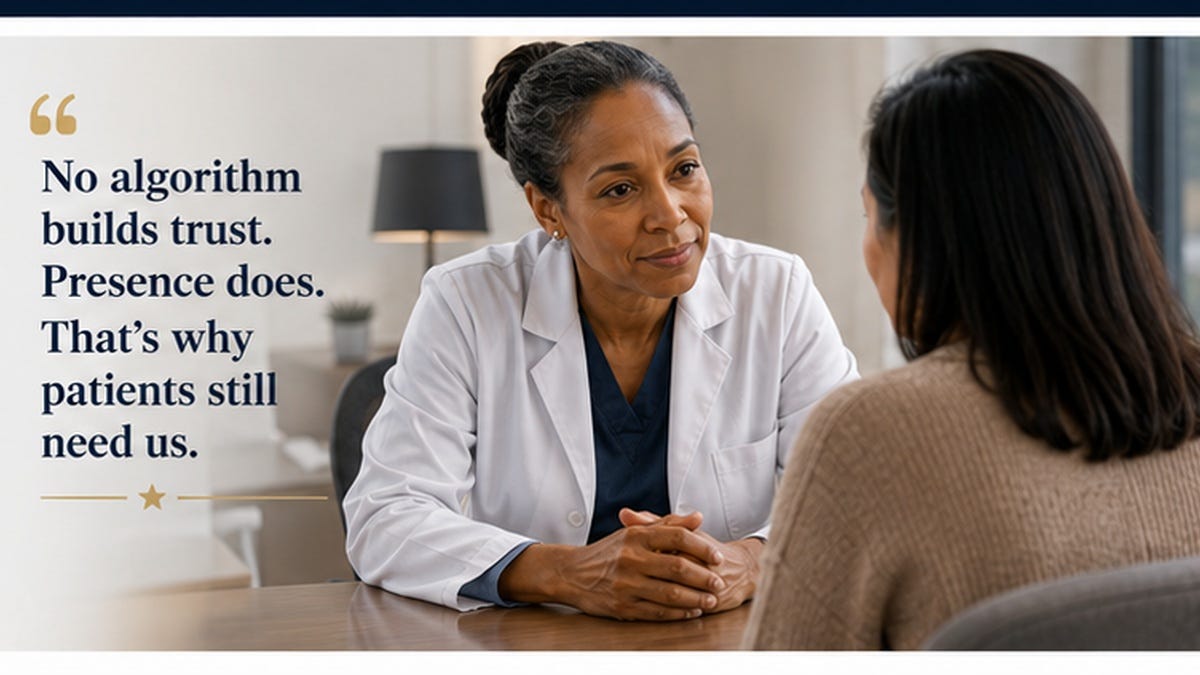
AI cannot walk into a room and know, before the patient says a word, that something has changed since last week.
That knowledge — the clinical intuition built from years of presence, from thousands of patient interactions, from the particular way a person holds themselves when they are in pain versus when they are afraid — is not a feature that can be engineered. It is learned. It is human. And in oncology, where patients are navigating one of the most frightening experiences of their lives, it matters.
AI cannot hold a family together in a consultation room while they absorb a terminal diagnosis. It cannot pace the conversation to what the patient can take in. It cannot detect that the patient’s daughter is crying while the patient is exerting strength, and adjust accordingly.
AI does not reliably navigate situations where guidelines are incomplete, conflicting, or inapplicable to the individual patient… and they don’t always fit. Oncology is full of patients who are the exception — whose comorbidities, whose prior treatment history, whose personal values place them outside the standard protocol. In those moments, clinical judgment is not a tiebreaker. It is the entire decision.
AI cannot assume clinical or legal accountability for a medical decision. When something goes wrong — and in medicine, things sometimes do go wrong — there must be a physician who can stand in that room, with that patient, and take responsibility. That accountability is not administrative. It is the foundation of the physician-patient relationship, and it is something no algorithm can assume.
And AI cannot build trust with a patient who has reason to distrust the system.
I think about this particularly in the context of communities that have been harmed by medicine historically — Black/African American patients, Indigenous patients, low-income patients who have been underserved or mistreated by the very institutions now asking them to interact with an AI-powered care management tool. The trust required for a patient to show up, to comply with treatment, to call when something is wrong — that trust is built person to person. Slowly. With consistency. With presence.
No algorithm builds that kind of trust on its own.
The Supervision Question Is Really a Values Question
I presented at the ACR Annual Meeting in 2024 on AI in rural radiation oncology. One of the most contested topics I addressed was supervision — specifically, whether AI-assisted remote oversight can maintain the standard of care in rural clinics that cannot recruit or retain a full-time radiation oncologist.
The debate is real. Some of my colleagues believe that any relaxation of direct in-person supervision requirements jeopardizes patient safety. I understand that position. I take patient safety with absolute seriousness. My training at AFRRI, my experience with RO-ILS incident data, my time opening clinics from the ground up — all of it has taught me how quickly things can go wrong and how important oversight structures are.
But I also know what happens to patient safety when there is no physician at all.
The patient who cannot access radiation treatment because the nearest clinic is 90+ miles away and the wait time is measured in weeks — his/her safety matters too. The veteran who doesn’t complete his cancer treatment because the logistics are impossible — his outcomes matter too.
The supervision question, framed purely as a clinical safety question, is incomplete. It is also a values question. Who do we focus on when creating oversight rules? Whose access do we consider standard, and whose do we view as unusual?
AI-assisted remote oversight, done with rigorous protocols, documented accountability, and a physician available for every critical decision, is not the same as no physician. It is a different model of physician presence — one designed for the reality of maldistributed specialty care, not the ideal of a fully staffed urban academic center.
I am not advocating for recklessness. I am advocating for honesty about what the current system already fails to provide.
What This Means for Physicians Asking the Question
If you are a clinician reading this and wondering about your relevance in a world where AI can contour, plan, predict, and flag — here is what I want to say to you directly:
The skills that AI is augmenting are the technical ones. The skills that remain irreplaceable are the human ones — presence, judgment, accountability, trust, and the ability to hold complexity that does not resolve into a data point.
If you are leaning into those skills — deepening your capacity for difficult conversations, your understanding of the patients who look nothing like the clinical trial populations, your ability to navigate the gray zones where guidelines fall short — you are not becoming obsolete.
You are becoming more essential.
The physician who understands both the technology and its limits — who can explain to a patient what the AI flagged and what it means, who can audit an algorithm’s recommendation with clinical judgment, who can ask the question the model didn’t know to ask — that physician is not replaceable.
That is the physician I am trying to be. Still learning. Still asking questions. Still convinced that the human element in medicine is not a sentimental attachment to the past.
It is the point.
One More Thing
I said at the outset that I wanted to give a real answer, not a reassuring one. So let me close with the part that is genuinely uncertain.
I do not know exactly what medicine will look like in twenty years. I do not think anyone does — including the people building the technology. What I know is that the decisions being made right now, about how AI is deployed, whose data it is trained on, who has access to it and who doesn’t, what oversight structures we require — those decisions will shape the answer.
Physicians are not passive recipients of that future. We are among the people who should be shaping it — asking the clinical questions, demanding equity in design, insisting on accountability, and staying in the room where these decisions are made.
That is not optional. That is our responsibility.
The patients who need us most are depending on us to get this right.
I am on a learning trajectory with AI — a physician asking the questions that clinical experience makes necessary. I don’t have all the answers. But I believe the right questions matter as much as the technology itself. If your organization is asking these questions too and wants a physician at the table, I’d welcome that conversation
📩 Interested in a speaking engagement or consulting opportunity? [Click here to connect.]
And if this piece was useful — subscribe for more, published every other Friday under the AI & Medicine tab.
— Dr. C.M. Williams, M.D.
Board-Certified Radiation Oncologist | Retired U.S. Army LTC
Founder, Questions 4 Cancer Doctors (Q4CD)
Q4CD.com |
Thanks for reading Questions 4 Cancer Doctors! Subscribe for free to receive new posts and support my work.