

PACT Act Presumptive Conditions: Why Your VA Disability Rating Is NOT Automatic
Presumptive is a doorway — not the finish line. Here's what the VA still requires to rate your claim

On Service, Exposure & Evidence — An Oncologist Veteran-to-Veteran Perspective

Why This Question Keeps Coming Up
Since the PACT Act passed, one question comes up more than almost any other — from veterans, from spouses, from adult children filing on behalf of a parent:
“If my condition is presumptive and I was there during the qualifying period, is my VA disability rating automatically granted?”
It is a reasonable question. An understandable assumption. And one of the most important misunderstandings I see in VA claims work. Learn the basics about the PACT Act HERE.
The short answer: Presumptive does not mean automatic.
Let me explain why — and what the VA actually still needs from you.
What “Presumptive” Actually Means (In VA Terms)
In VA language, presumptive means the VA agrees not to require proof that your military service caused your condition — as long as you meet:
specific location
specific timeframe, and
specific diagnosis criteria.
That is an important legal shortcut. It removes the causation debate. But it is only one step in the process.
The VA still must confirm you have a qualifying diagnosis, determine whether the condition is active or producing ongoing residual effects, and apply rating criteria outlined in federal regulation.
Presumptive status removes the need to prove why you got sick. It does not remove the need for medical documentation about how sick you are.
Being “There” Is Necessary — But Not Sufficient
Many veterans stop at “I was there.” They confirm their deployment on their DD-214, confirm the timeframe, and assume the claim is complete. Presence in a qualifying area is essential. But it is not the finish line.
The VA still evaluates:
• Whether your medical condition meets diagnostic standards
• Whether it is currently active, in remission, or producing residual effects
• How severe the condition is under VA rating criteria
Service connection and disability rating are two separate decisions. You can receive service connection and still have a claim stall or come back lower than expected — because the medical picture wasn’t documented clearly enough.
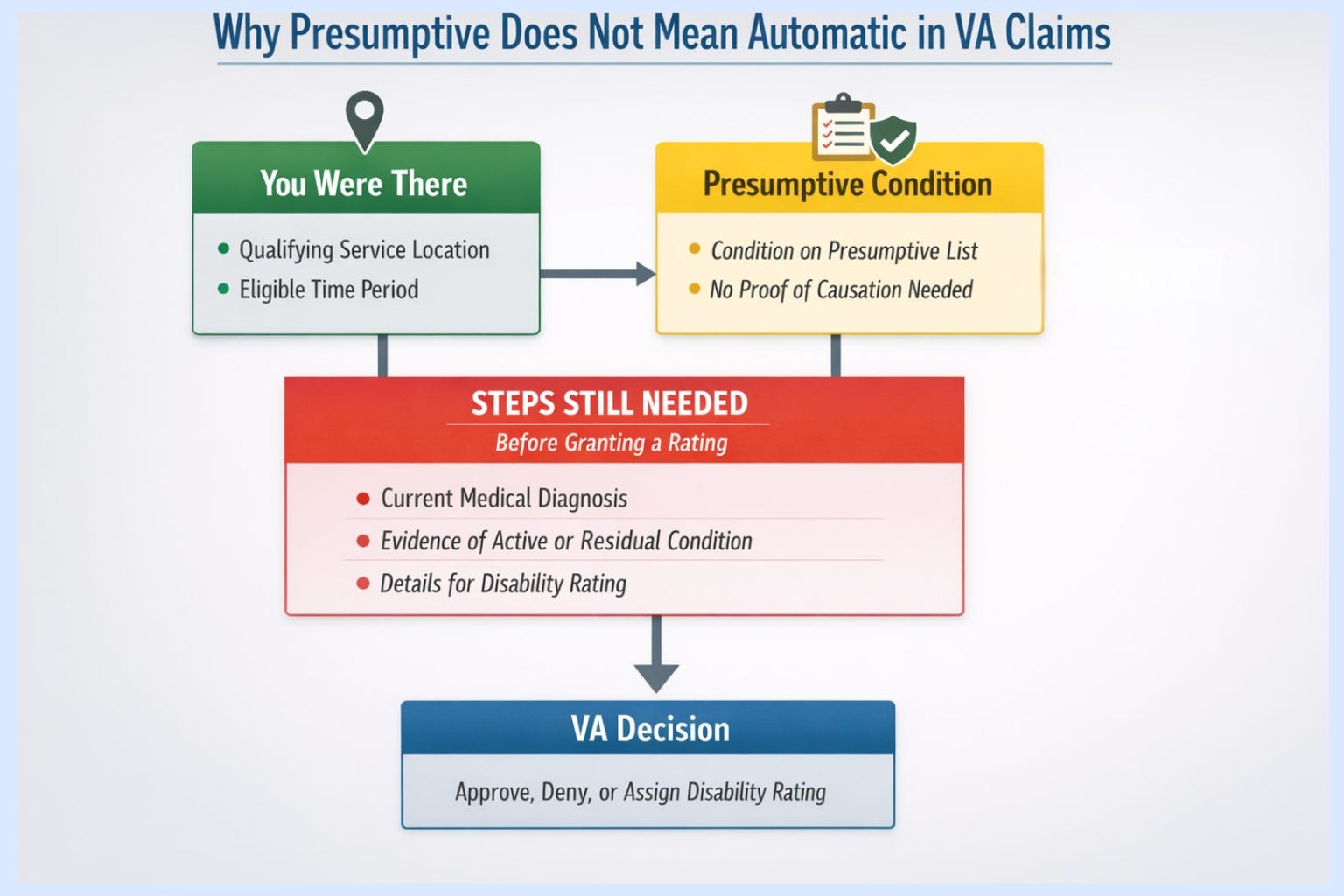
What the VA Still Needs — Even for Presumptive Claims
1. A Confirmed Diagnosis
The VA requires medical evidence of a diagnosis that meets accepted standards. For cancer: pathology or biopsy reports, oncology notes, imaging and lab results, and treatment summaries.
2. Evidence of Current Status
Is the condition active, in remission, or stable with ongoing residuals? This distinction directly affects rating. Active cancer is often rated at 100%. Post-treatment status may be rated on residual symptoms — not the original diagnosis.
3. Information Needed for Rating
Even when service connection is established, the VA must assign a percentage. That requires severity indicators, functional impact, treatment history, and residual complications. This is where most claims stall — not eligibility, but documentation.
Where Nexus Letters and DBQs Fit In
For presumptive conditions, a Nexus Letter is often unnecessary for service connection. The law has already established that link.
However, medical opinions and DBQs can still be helpful when the diagnosis is complex or atypical, the condition is no longer active but has significant ongoing residuals, or there is disagreement about recurrence, progression, or severity.
Used appropriately, these tools support clarity. Used indiscriminately, they can create confusion — and unnecessary expense.
Why Presumptive Claims Still Get Delayed or Denied
Common reasons include missing medical records, outdated documentation, misunderstanding of rating criteria, and lack of clarity about disease status.
A denial does not always mean the veteran is ineligible. Often, it means the VA did not have enough information to rate the claim correctly.
Clarity does not weaken a claim. It strengthens it.
The Bottom Line: Presumptive Is a Doorway, Not the Finish Line
The PACT Act represents real, meaningful progress for veterans exposed to toxic hazards. But presumptive status is a starting point — not a guarantee.
Veterans who understand what the VA still requires are better positioned to advocate effectively, avoid unnecessary delays, and reduce frustration. Education is one of the most powerful tools in this process. Need assistance? Schedule a VA Case Strategy Consult.
If you are navigating a VA claim involving cancer, toxic exposure, or complex medical documentation — and you want a physician to help clarify what your records say and what they still need — that is the work I do.
Visit Q4CD.com to learn more about Veterans Medical Review Services, including Medical Record Readiness Reviews, Nexus Opinion Reviews, and Independent Medical Opinions.
This article is for educational purposes only. It does not constitute medical, legal, or VA claims advice, and does not establish a physician-patient relationship.
Until next time — live, laugh, and love on purpose.
Warm regards,
Dr. C.M. “Queen” Williams, M.D.
Radiation Oncologist | Army Veteran | Founder, Q4CD
Q4CD.com | clarity.Q4CD.com
If this was helpful, share it with a veteran or family member navigating the VA. And if you haven’t subscribed yet — join us here. More coming each week.