

VA Form 21-4138 Personal Statement: How Veterans Can Help Connect the Dots In A VA Claim
VA Statements in Support of Claim: what to say, what to avoid, and why structure matters

On Service, Exposure & Evidence — An Oncologist Veteran-to-Veteran Perspective
I was enlisted for many years, but it wasn’t until I became an officer and approached retirement that I fully understood the importance of benefits, documentation, and maintaining a thorough written record.
As an enlisted soldier, I ETS’d without much thought about future benefits. That was my short-timer’s blind spot. I was ready to move forward, and I did not yet understand how much those records might matter later.
By default, I had my medical, dental, and training records — or at least copies — because we had to carry them to each new base assignment. But nobody sat me down and said,
“This is going to be important. Keep a copy forever. One day, you may need these records to help tell your story.”
I learned some things later, than I wish I had.
That is one reason I do this work now. Not to scare veterans. Not to overpromise. Not to make the VA claim process sound simple … when it is not.
I do this because many veterans were never taught how to organize their own story in a way that helps their records make sense.
Based on the medical record reviews I have done, many veterans either skip, rush, overload, or treat this form like an afterthought:
VA Form 21-4138, Statement in Support of Claim — often called a Personal Statement.
Depending on your claim and how you submit it, VA may direct you to use another supporting-statement form, including VA Form 21-10210 for lay or witness statements. Always confirm the current form with VA.gov, your VSO, accredited claims agent, or attorney before submitting anything.
But the principle is the same: your records matter. Your statement helps explain what those records may not clearly say.
What Is a VA Personal Statement?
A VA Personal Statement is your opportunity to explain, in your own words, what happened, when it started, how your symptoms developed, and how your condition affects your daily life.
Your service records may show where you served. Your medical records may show a diagnosis, treatment, imaging, medications, or procedures. But those records do not always explain the lived experience.
They may not show:
Your MOS, duty, exposure, point of injury, or work environment
When you first noticed symptoms
How the condition changed over time
What activities you stopped doing
How symptoms (such as pain, fatigue, breathing problems, anxiety, numbness, weakness, or scars) may affect your day-to-day life
That is where a clear, factual Personal Statement can help.
It should not replace medical evidence. It should help organize the story around the evidence. The story around you.
The Personal Statement Is a Bridge
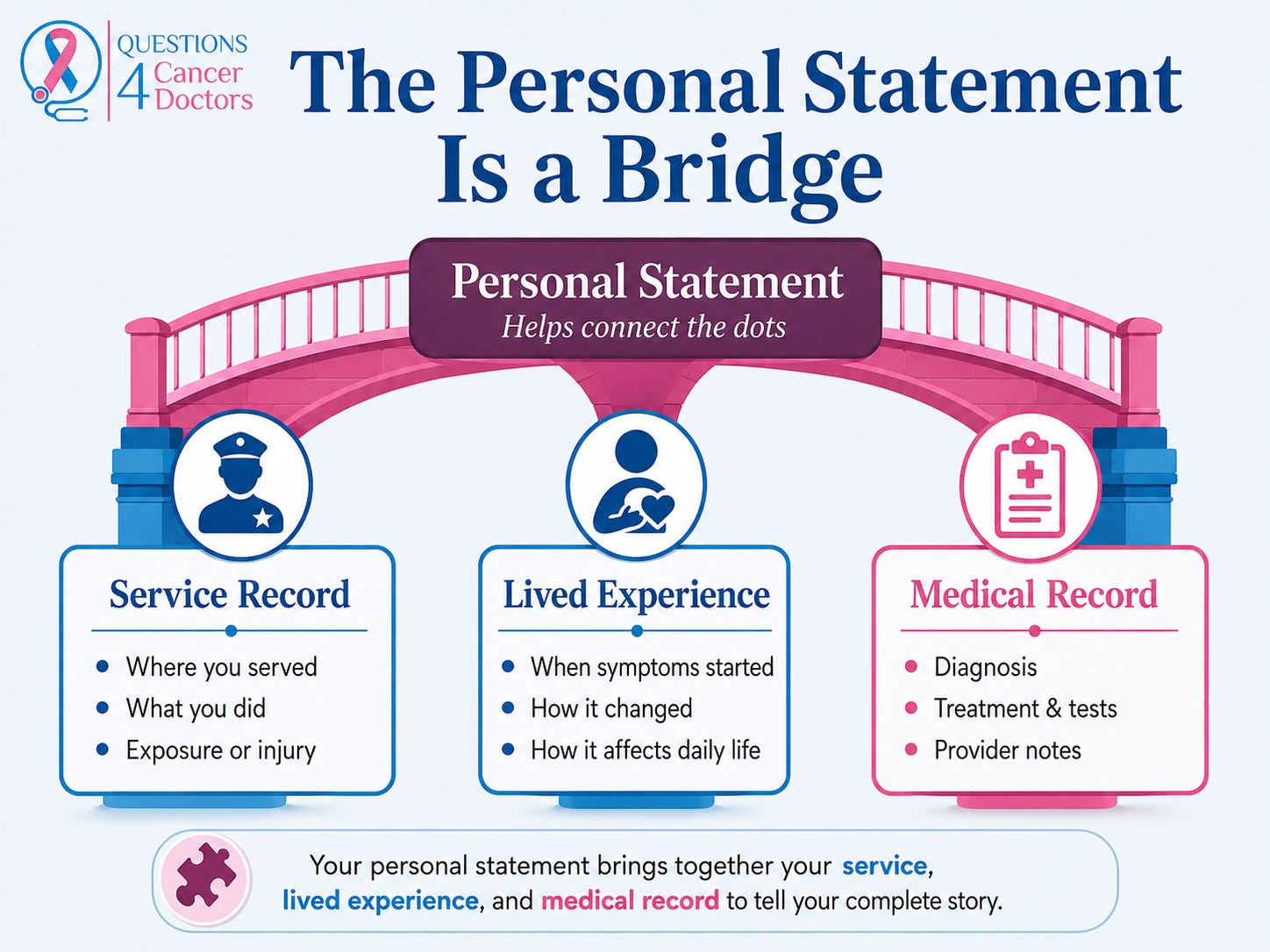
Think of your VA claim as three pieces:
Your service record — where you served, what you did, when you served, and what exposures, duties, events, or injuries may have occurred.
Your medical record — diagnoses, symptoms, test results, imaging, pathology, treatment notes, surgery reports, medications, and follow-up care.
Your lived experience — how this condition affects your body, your work, your sleep, your mobility, your relationships, your independence, and your daily life.
The Personal Statement helps connect those three pieces.
It does not need to be dramatic. It does not need to be long. It does not need to sound like a lawyer wrote it. It does not need to sound like AI wrote it.
It needs to be clear. It need to be in your voice. It need to be about you.
A strong statement helps answer:
What happened?
When did it start?
How has it changed?
How does it affect you now?
What evidence supports what you are saying?
What Veterans Should Include in a VA Personal Statement
Here is a simple structure veterans may use when preparing a Personal Statement.
1. Identify the condition or issue
Start by naming the condition or symptom area you are discussing. Keep the opening simple.
“I am submitting this statement in support of my claim for chronic back pain.”
“I am submitting this statement in support of my claim related to respiratory symptoms after deployment.”
“I am submitting this statement in support of my claim involving cancer and toxic exposure concerns.”
2. Explain the service event, duty, exposure, or injury
Be specific. Avoid vague phrases like: “I was exposed to a lot of STUFF.”
Instead, write what you know:
Where you were stationed or deployed
Approximate dates or timeframe
Your MOS, duty, or work environment
Known exposure concerns
Injury, accident, event, or repeated physical stress
Relevant deployment conditions
For toxic exposure or cancer-related claims, this may include burn pits, jet fuel, solvents, contaminated water, radiation, chemicals, occupational hazards, or other exposure concerns.
Do not exaggerate. Do not guess. Say what you know and what you personally experienced.
3. Describe when symptoms started and how they changed
A timeline matters. You do not have to remember every exact date, but you should try to give the clearest timeline you can.
Helpful questions:
Did symptoms start during service?
Did they begin soon after separation?
Did they develop years later?
Did they worsen over time?
Did you seek medical care?
Did you self-manage before finally getting evaluated?
Examples:
“I first noticed shortness of breath during deployment, especially after physical training. After returning home, I continued to have coughing episodes and gradually noticed I could not exercise the way I used to.”
Or:
“My pain began after repeated lifting and carrying during service. At first, I managed it with over-the-counter medication, but over time it became more frequent and began affecting my ability to sit, stand, and sleep.”
4. Describe daily impact in real-life terms
This is the section many veterans write too generally.
Instead of saying: “My knee hurts.”
Say:
“My knee pain makes it difficult to climb stairs. I avoid kneeling because I may not be able to get back up without support. I cannot stand longer than about [number] minutes without needing to sit.”
Instead of saying: “I am tired.”
Say:
“Tiredness causes me to stop activities after a short period. I need to rest after basic household tasks, and I no longer have the stamina I had before treatment.”
Concrete details help. Your Personal Statement should explain how the condition shows up in ordinary life.
Examples of daily impact:
Trouble sleeping
Difficulty walking, standing, sitting, lifting, bending, or climbing stairs
Needing help with household tasks
Avoiding certain activities
Missing work or changing work duties
Pain with movement
Fatigue/Tiredness after treatment
Shortness of breath
Neuropathy, numbness, weakness, or balance issues
Scars, skin changes, or surgical complications
Do not pack every single symptom into your statement. Stay factual. Stay specific.
5. Point to supporting evidence
Do not assume the reviewer will automatically know which records matter most. If you have supporting records, point to them.
Examples:
Private medical records
VA treatment notes
Imaging reports
Oncology/cancer records
Radiation therapy summaries
Medication lists
Buddy statements
You might write:
“My oncology (cancer) records from March 2024 show the diagnosis and treatment plan.”
Or:
“My post-operative follow-up notes describe ongoing pain, scar sensitivity, and limitations.”
The goal is to help the record tell a clearer story.
What Veterans Should Avoid in a Personal Statement
A Personal Statement should be honest, organized, and useful. Here are a few things to avoid.
Avoid self-diagnosing
Describe what you experienced. Let medical records and qualified medical professionals address diagnosis.
Instead of: “I know my cancer was caused by burn pits.”
Consider: “I served near burn pit exposure during deployment. I was later diagnosed with cancer. I am submitting this statement to explain my service history, exposure concerns, diagnosis, and treatment records.”
That keeps the statement factual.
Avoid rambling
One statement should usually focus on one condition or one connected issue. If you are discussing several unrelated conditions, consider organizing them separately so each issue is clear.
The reviewer should not have to dig through pages of unrelated information to find your point.
Avoid using the statement only to vent
The VA process can be frustrating. Many veterans have every right to feel tired, dismissed, delayed, or confused.
But the Personal Statement is not the best place to unload that frustration.
Keep it focused on:
What happened
What you experienced
How it affects you
What evidence supports it
That is how you make the statement useful.
Avoid copying generic language from the internet
Templates can help with structure, but your statement should sound like your life.
Your facts matter. Your timeline matters. Your symptoms matter. Your medical records matter.
Use a template if needed, but do not let a template erase your actual story.
A Simple VA Personal Statement Framework
Here is a plain-language structure you can follow:
Opening: “I am submitting this statement in support of my claim for [condition].”
Service connection or exposure: “During my service, I [describe event, duty, injury, exposure, location, or timeframe].”
Symptoms and timeline: “I first noticed [symptoms] around [timeframe]. Since then, [describe how symptoms changed].”
Daily impact: “This affects my daily life by [specific examples].”
Evidence: “My records from [date/provider/type of record] support this, including [brief description].”
Closing: “I am providing this statement to help explain my symptoms, timeline, daily limitations, and supporting records.”
That is enough.
Clear is better than dramatic.
Organized is better than long.
Specific is better than emotional.
Why This Matters for Cancer, Toxic Exposure, and Complex Medical Claims
For veterans with cancer, toxic exposure concerns, or complicated medical histories, the record can become difficult to follow.
There may be:
Service records
Deployment history
Exposure concerns
Civilian medical records
VA medical records
Oncology consultations
Surgery notes
Pathology reports
Radiation treatment summaries
Chemotherapy records
Survivorship follow-up notes
Late effects or residual symptoms
That is a lot. And in a language that is dense for many - Medical Lingo - can quickly become overwhelming.
A Personal Statement can help explain how the pieces fit together from the veteran’s point of view.
Again, the statement does not replace medical evidence. It helps point to it.
Veteran to Veteran: Do Not Treat This Like a Small Form
I started my military career as an enlisted Soldier and later retired as an Army Lieutenant Colonel. I am also a physician with a specialty in cancer care - Radiation Oncology.
I know what it feels like to find out late that there were things I should have been taught earlier.
That is why I am saying this plainly:
Do not treat your Personal Statement like a throwaway form.
Do not rush it.
Do not turn it into a novel.
Do not use it to diagnose yourself.
Use it to tell the truth clearly.
Your service record may show where you were.
Your medical record may show what was diagnosed.
Your Personal Statement helps explain how it affected you.
That matters.
Need Help Understanding Your Medical Records?
If you are working on a VA claim involving cancer, toxic exposure, complex medical documentation, or post-treatment residuals, you may need help understanding what your records actually say — and what may still be missing.
That is part of the work I do through Questions 4 Cancer Doctors (Q4CD) Veterans Medical Review Services.
A VA Case Strategy Consult is not a guarantee of benefits. It is not legal representation. It does not replace your VSO, accredited claims agent, attorney, or VA healthcare team.
It is a physician-led review to help you better understand your medical records, cancer history, treatment timeline, residual symptoms, and questions to ask as you prepare.
Learn more at: Q4CD.com
If you are navigating a VA claim involving cancer, toxic exposure, or complex medical documentation — and you want a physician to help clarify what your records say and what they still need — that is the work I do.
Visit Q4CD.com to learn more about Veterans Medical Review Services, including Medical Record Readiness Reviews, Nexus Opinion Reviews, and Independent Medical Opinions for DIC.
This article is for educational purposes only. It does not constitute medical, legal, or VA claims advice, and does not establish a physician-patient relationship.
Until next time — live, laugh, and love on purpose.
Warm regards,
Dr. C.M. “Queen” Williams, M.D.
Radiation Oncologist | Army Veteran | Founder, Q4CD
Q4CD.com | clarity.Q4CD.com
If this was helpful, share it with a veteran or family member navigating the VA. And if you haven’t subscribed yet — join us here. More coming each week.