

Bladder Cancer: Agent Orange, Camp Lejeune & Non-Presumptive Bladder Cancer
What Veterans and Families Need to Know About VA Benefits for Bladder Cancer Claims

On Service, Exposure & Evidence — An Oncologist Veteran-to-Veteran Perspective

If your VA bladder cancer claim was denied — or you have not filed yet because you did not believe you would qualify — please stop what you are doing and read this carefully.
Bladder cancer is an important consideration in veteran health, particularly when toxic exposure may have played a role in its development. Many veterans and families are uncertain whether they qualify for VA benefits — especially when a claim has been denied or never filed.
As a physician who has reviewed cases like these, I often see situations where the relationship between a diagnosis and a service history was never fully developed — even when the exposure record suggests a possible pathway. This article reviews the main routes that may apply and explains the medical evidence that often matters most.
Agent Orange and Presumptive Service Connection
The first thing most veterans do not know:
Bladder cancer is a presumptive condition under Agent Orange exposure.
Bladder cancer is recognized by the Department of Veterans Affairs as a presumptive condition associated with herbicide exposure, including Agent Orange. [VA source]
Veterans who served in qualifying locations — including Vietnam, certain areas of the Korean DMZ, Thailand bases, and other recognized exposure settings — may qualify for presumptive service connection.
Under a presumptive framework, the VA accepts the recognized association between exposure and disease without requiring the veteran to independently prove causation.
Presumptive status reduces the evidentiary burden — but it does not make the process automatic. Incomplete records or unclear documentation can still lead to delays or errors in how a claim is adjudicated/processed.
Presumptive does not mean automatic.
In other words, it means the burden of proof shifts — but you still have to file correctly. You still have to document your service location. You still have to make sure the VA actually sees and records the connection between your diagnosis and your service history.
Filing without guidance is one of the most common reasons these claims get denied or likely assigned a low rating — not because the evidence was not there, but because no one organized it properly.
If you were exposed to Agent Orange and you have a bladder cancer diagnosis, this may be a presumptive situation worth reviewing with someone who understands how to build the file correctly.
[Learn more about Agent Orange presumptive conditions]
Camp Lejeune Water Contamination
Individuals who lived or worked at Marine Corps Base Camp Lejeune between 1953 and 1987 were exposed to contaminated drinking water containing compounds including trichloroethylene, tetrachloroethylene, benzene, and vinyl chloride — substances well documented as carcinogenic.
The VA recognizes bladder cancer as a presumptive condition for Camp Lejeune-related exposure. Bladder cancer is recognized as a Tier 1 condition under the Camp Lejeune Justice Act — the highest level of recognized connection between that exposure and a bladder cancer diagnosis. Camp Lejeune veterans have two paths they may be able to pursue — talk to your credentialed VA personnel about next steps and how to file correctly. [Learn more about Camp Lejeune water contamination and VA benefits]
When Your Bladder Cancer Is Non-Presumptive — And What That Actually Means
Not every veteran fits neatly into the Agent Orange, Camp Lejeune, or other PACT Act presumptive diagnosis categories. Maybe you were exposed to burn pits. Maybe you handled industrial chemicals or solvents during your service. Maybe you were stationed somewhere the VA has not yet officially recognized.
Before you assume your case has no path forward, check the PACT Act. Still uncertain - scheduled a VA Case Strategy Consult.
The 2022 PACT Act significantly expanded toxic exposure coverage and added new presumptive conditions (check the list regularly for updates). Many veterans who believe they have a non-presumptive situation actually qualify for a presumption now — they simply have not been told.
The Role of Medical Nexus Evidence
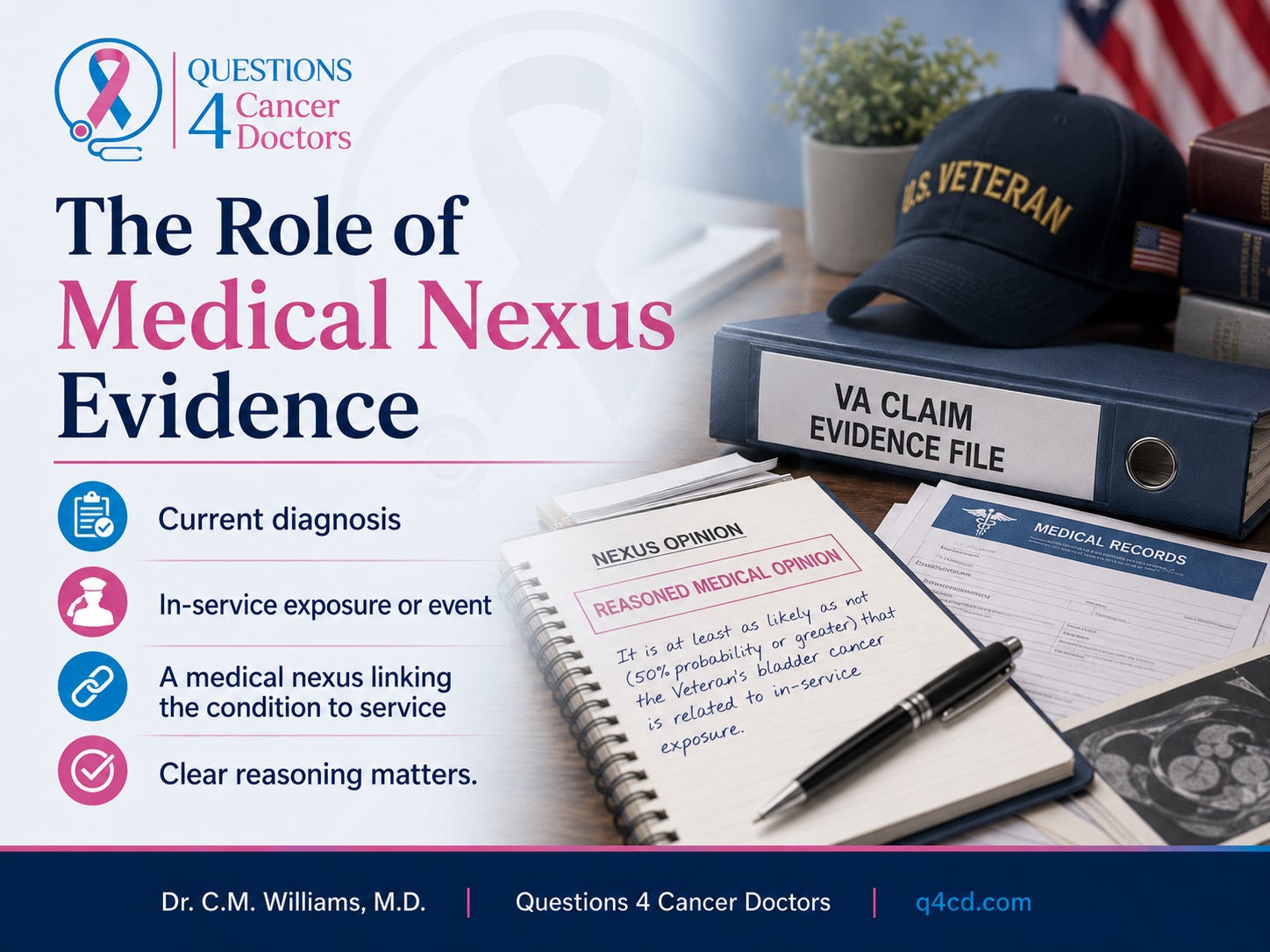
For non-presumptive claims, medical evidence becomes the foundation of the case.
The VA generally looks for three elements:
A current diagnosis.
Evidence of an in-service event, exposure, or illness.
A medical nexus linking the condition to service.
A nexus opinion is a formal medical assessment that addresses whether your condition is related to your military service. Strong opinions typically include a review of service records, medical records, and relevant exposure history, along with clear clinical reasoning grounded in the applicable literature and research.
In some cases, additional pathways may apply — including secondary service connection or aggravation of a pre-existing condition. A medical record review can help identify what is present in a file and what may need to be developed further.
Considerations for Surviving Family Members

For surviving spouses and dependents, Dependency and Indemnity Compensation (DIC) may be available if a veteran’s death is connected to service.
DIC may apply when bladder cancer was already service-connected, when a connection could have been established with stronger evidence, or when the condition contributed to the veteran’s death. Even when a veteran did not file or complete a claim during their lifetime, a review of the service and medical record may still identify a possible pathway.
Moving Forward
Bladder cancer claims — whether presumptive or non-presumptive — often depend on how clearly the medical and service evidence are presented and documented.
A structured review may help clarify whether:
• A presumptive pathway applies.
• Additional medical evidence is needed.
• A prior denial may warrant another look.
• A survivor claim may still be open.
At Q4CD, I provide physician-led medical record reviews, nexus letter, or independent medical opinions to help veterans and families better understand their cases from a clinical perspective. If you are looking for a physician’s review of your file, you may schedule an initial consult here.
Frequently Asked Questions
Is bladder cancer a presumptive condition for Agent Orange exposure?
Yes. Bladder cancer is recognized as a presumptive condition under Agent Orange exposure. If you served in a qualifying location, time frame and have a bladder cancer diagnosis, the VA accepts bladder cancer as a presumptive condition. However, you still need to file correctly and document your service history.
Does Camp Lejeune water contamination cover bladder cancer?
Yes. Bladder cancer is a Tier 1 condition under the Camp Lejeune Justice Act — the highest recognized level of connection to the contaminated water at Marine Corps Base Camp Lejeune between 1953 and 1987. Veterans and certain family members may have claims through the VA disability system and other options.
What is a nexus letter, and why does it matter for a VA bladder cancer claim?
A nexus letter in this setting, is a formal written medical opinion from a qualified oncologist physician (cancer doctor) establishing the medical connection between a veteran’s bladder cancer diagnosis and their military service. For non-presumptive claims, this letter is the foundation of the entire case. The letter is best written by a board-certified oncologist who has reviewed your military service records and documented that review explicitly.
Can family members pursue VA benefits related to a veteran’s bladder cancer?
Yes. If you are a surviving spouse or dependent of a veteran whose death was connected — or potentially connected — to military service through bladder cancer, you may be eligible for Dependency and Indemnity Compensation (DIC). Even if service connection was never formally established before the veteran’s passing, there may still be options worth exploring.
Does the PACT Act cover bladder cancer?
The 2022 PACT Act significantly expanded presumptive conditions and toxic exposure coverage. Some veterans with bladder cancer who believed they faced a non-presumptive situation may now qualify for a presumption under PACT Act provisions. It is worth reviewing your specific service and exposure history before assuming your case must be argued as non-presumptive.
What should I do if my VA bladder cancer claim was denied?
A denial is not the final word. Review the denial letter carefully — it will specify the reasons. Common reasons include insufficient medical nexus, incomplete service documentation, or inadequate Compensation and Pension (C&P) exam findings. A physician-led medical record review can identify what may have been missed. Timelines matter after a denial, so seek guidance promptly rather than waiting.
If you are navigating a VA claim involving cancer, toxic exposure, or complex medical documentation — and you want a physician to help clarify what your records say and what they still need — that is the work I do.
Visit Q4CD.com to learn more about Veterans Medical Review Services, including Medical Record Readiness Reviews, Nexus Opinion Reviews, and Independent Medical Opinions as well as Dependency and Indemnity Compensation (DIC).
This article is for educational purposes only. It does not constitute medical, legal, or VA claims advice, and does not establish a physician-patient relationship.
Until next time — live, laugh, and love on purpose.
Warm regards,
Dr. C.M. “Queen” Williams, M.D.
Radiation Oncologist | Army Veteran | Founder, Q4CD
Q4CD.com |
If this was helpful, share it with a veteran or family member navigating the VA. And if you haven’t subscribed yet — join us here. More coming each week.