

Nexus Letter vs. IMO: Which One Do You Need? Cancer, Toxic Exposure & DIC in VA Cases
A physician-veteran's plain-language guide to medical nexus opinions for cancer, toxic-exposure, and DIC cause-of-death claims.

On Service, Exposure & Evidence — An Oncologist Veteran-to-Veteran Perspective
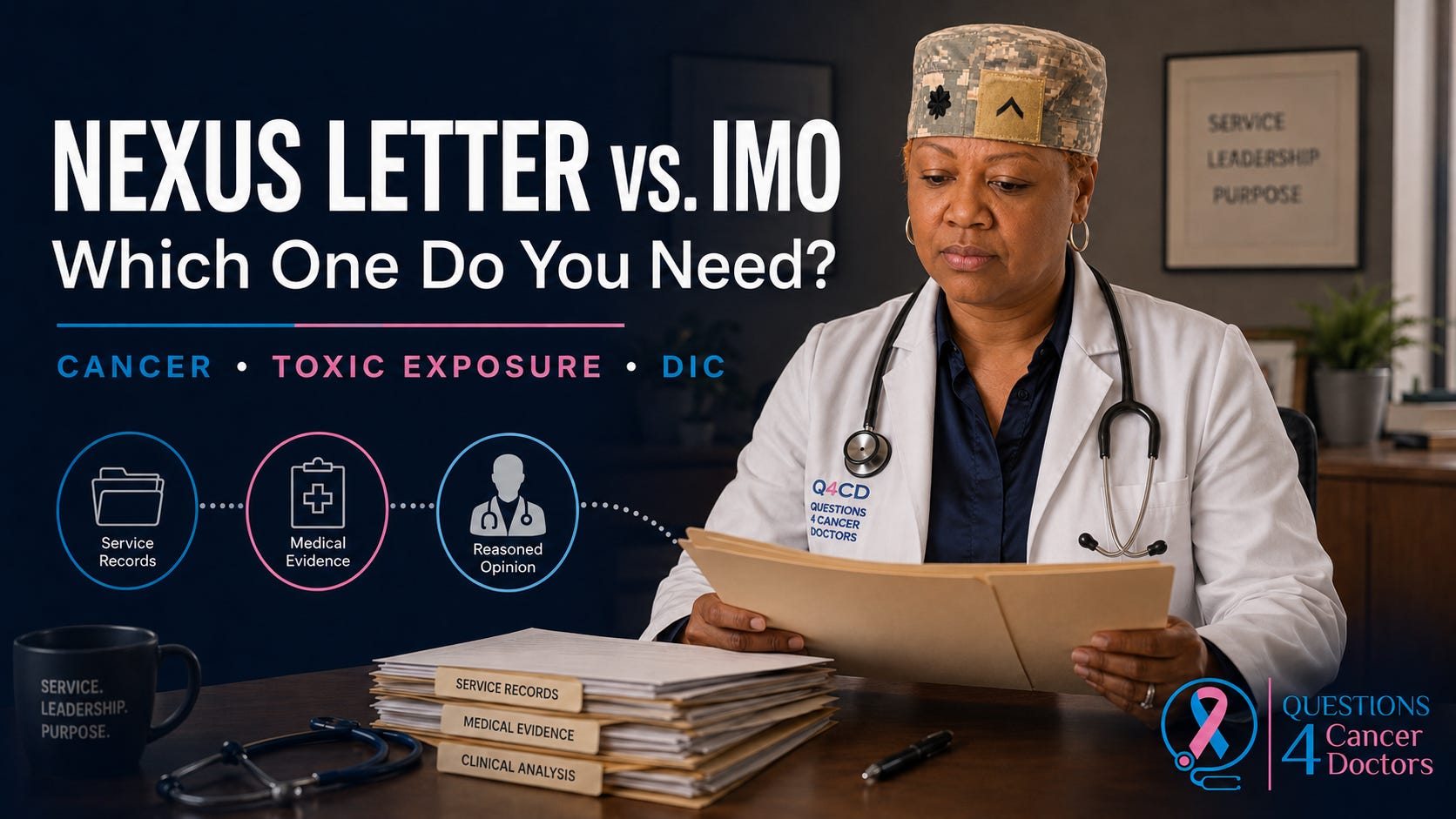
A viewer named Jonathan wrote to me recently. He is helping his mother file for Dependency and Indemnity Compensation (DIC) after his father, a retired service member, passed away.
“I am not military,” he told me. “I keep hearing nexus letter and IMO. I do not know which one we need.”
If you are filing your own cancer-related VA disability claim, or helping a parent or spouse with a DIC claim, you may be asking the same question. These terms are often used as though they describe two completely different documents. They do not. There is an overlap.
The short answer: The label is not the deciding factor. What matters is whether the medical opinion is written by a competent clinician, answers the exact question the VA must decide, uses an accurate factual record, and explains the reasoning behind the conclusion. In a cause-of-death DIC claim, that question is often whether a service-connected condition was the principal cause of death or contributed substantially or materially to the Veteran’s death.
{see the YouTube video link and other important links at bottom of page}.
What a Direct Service-Connection Claim Usually Needs
For direct service connection, the evidence generally needs to establish three things:
A current diagnosed disability
An illness, injury, exposure, or event during military service
A medical link between the current disability and the in-service event - the nexus
Put simply: the diagnosis tells the VA what condition exists. Service records and other evidence help establish what happened during service. The nexus explains how the two are medically connected.
A presumption can change that analysis. When both the Veteran’s qualifying service and diagnosed condition meet the requirements for a VA presumption, the law may supply the connection and reduce the need for a separate private nexus opinion. That is why the first question should not be, “Where can I buy a letter?” It should be, “What element of this claim is actually missing?”
What Is a Nexus Letter?
A nexus letter is the common, nontechnical name for a medical opinion that addresses the relationship between a condition and military service, an exposure, or another service-connected disability. The opinion may address direct service connection, secondary service connection, aggravation, toxic exposure, or another defined medical question.
The clinician should have education, training, or experience appropriate to the issue. Specialty alignment can strengthen the opinion in a complex case, but the title on the clinician’s business card is not enough by itself. The report still needs accurate facts and sound medical reasoning.
A useful nexus opinion does more than state a diagnosis and add a phrase such as “at least as likely as not.” That conclusion may be appropriate, but it is not a magic sentence. The clinician should identify the relevant records, explain the medical reasoning, and connect the evidence to the conclusion.
What Is an Independent Medical Opinion (IMO)?
In the Veterans’ claims community, IMO often refers to a private, independent medical opinion prepared after a detailed review of the records. It may include the clinician’s qualifications, the medical question presented, the Veteran’s service and medical history, the records reviewed, scientific literature, competing risk factors, and a reasoned conclusion.
Here is the part many people miss: there is no universal VA rule that a document called an IMO must be longer, more formal, or more persuasive than a document called a nexus letter.
A nexus letter can be comprehensive.
An IMO can be weak.
VA decision-makers evaluate the substance of the opinion, not merely the heading at the top of the page.
Some complex cancer or toxic-exposure reviews do require many pages. A recent opinion I prepared exceeded 15 pages because the record, exposure analysis, medical literature, and alternative risk factors required that depth. Fifteen pages is not a benchmark. The length should follow the complexity of the medical question.
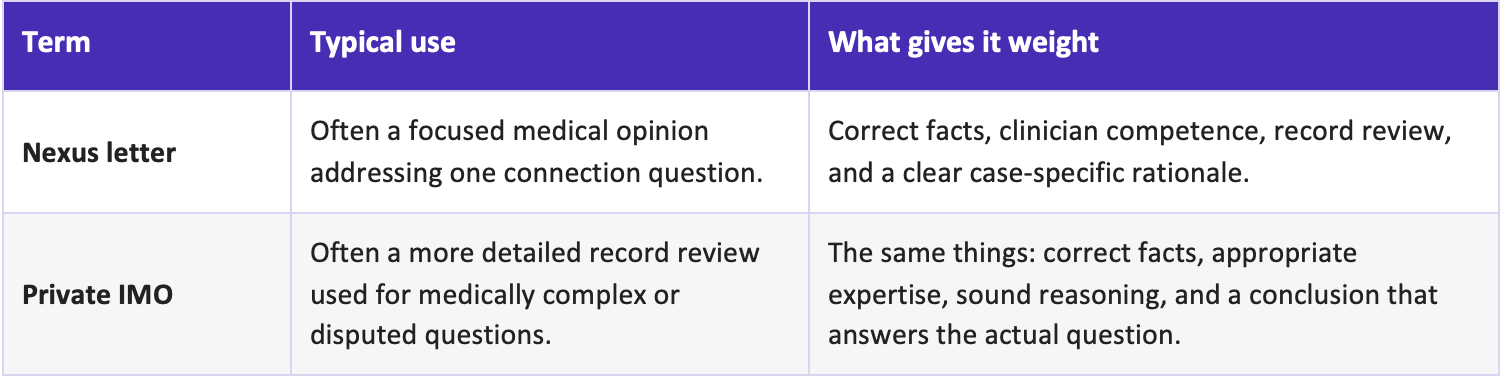
Nexus Letter vs. IMO: The Practical Difference
These are common usage patterns, not rigid VA categories.

What Makes a Medical Opinion Persuasive?
A well-supported opinion should usually make the following clear:
The exact medical question: Is this direct service connection, secondary service connection, aggravation, toxic exposure, or cause of death?
The clinician’s qualifications: The report should explain why the clinician is competent to address this medical issue.
The records reviewed: Relevant service records, medical records, imaging, pathology, prior examinations, and decision documents should be identified.
The factual foundation: An opinion built on an incorrect diagnosis, date, exposure history, or service location can unravel quickly.
Timing and latency: The clinician should explain whether the time between service, exposure, symptoms, and diagnosis is medically consistent with the proposed connection.
Competing risk factors: Smoking, age, family history, occupational exposures, infections, and other causes should be addressed when relevant - not ignored and not treated as false either.
The medical rationale: Medical literature can support an analysis, but pasted research is not a substitute for explaining how the evidence applies to the Veteran.
A clear conclusion: The opinion should directly answer the question using the appropriate evidentiary language and explain why the evidence supports that conclusion.
When Might a Private Medical Opinion Be Useful?
A private opinion may be especially useful when:
The claimed condition is not covered by a presumption
The claim involves a toxic exposure risk activity (TERA) or another complicated exposure history
The condition was diagnosed long after service and the medical latency needs explanation
There are several plausible causes or significant competing risk factors
The claim involves secondary service connection or aggravation
A VA examiner issued an unfavorable opinion that appears incomplete, internally inconsistent, or based on an inaccurate history
The VA denied the claim because the medical connection was not established
A DIC claim requires a retrospective opinion about the principal or contributory cause of death
When Might You Not Need to Pay for One?
Not every Veteran or survivor needs a private nexus letter or IMO. It may add little when:
A presumption already establishes the link and the service and diagnosis requirements are documented
The record already contains a favorable, adequate medical opinion
The missing evidence is not medical - for example, proof of qualifying service, exposure location, marriage, dependency, or another eligibility fact
The condition falls under the PACT Act
You are considering filing a High Level Review (HLR)
Before paying for an opinion: Read the VA decision letter carefully. Identify the favorable findings, the specific reason for denial, and the exact element the VA says is missing. A beautifully written medical opinion cannot repair a non-medical evidence gap.
Where a New Medical Opinion Fits After a VA Decision
A medical opinion can be submitted with an initial claim. After a denial, the correct review lane matters.
Supplemental Claim: This lane is designed for new and relevant evidence, which may include a new medical opinion.
Board Appeal: The Evidence Submission and Hearing options allow new evidence within defined windows. Direct Review does not allow new evidence.
Higher-Level Review: You cannot submit new evidence. The reviewer considers the existing record and looks for an error or a difference of opinion - no new IMO or Nexus.
Choosing a decision-review lane is legal and procedural strategy. Confirm the current rules and deadlines with a VA-accredited VSO representative, claims agent, or attorney before deciding.
How This Applies to DIC Claims
DIC is a tax-free monetary benefit for certain eligible survivors. In broad terms, DIC may be available when a service member died in the line of duty, when a Veteran’s death resulted from a service-related injury or disease, or in certain cases when the Veteran had a qualifying total disability rating for the required period before death.
That last route matters. If a survivor may qualify based on the Veteran’s total disability rating history, the cause of death may not be the missing issue. A cause-of-death medical opinion may therefore be unnecessary for that particular path. This is one reason to have a VA-accredited representative review eligibility before purchasing medical work.
The medical question in a cause-of-death DIC claim
For a cause-of-death DIC claim, federal regulation asks whether a service-connected disability was the principal cause of death or a contributory cause of death.
Principal cause: The service-connected disability was the immediate or underlying cause of death, was jointly responsible with another condition, or was medically related to the cause of death.
Contributory cause: The service-connected disability contributed substantially or materially, combined to cause death, or aided or lent assistance to the production of death. Merely showing that the condition existed is not enough; there must be a causal connection.
This distinction is critical. A DIC opinion should not simply repeat that the Veteran had a service-connected disability. It should explain whether and how that disability caused death, materially contributed to death, or affected the Veteran’s ability to withstand the condition that ultimately caused death - when the records support that conclusion.
Why DIC opinions are retrospective
The Veteran is no longer available for an examination, so a DIC opinion is usually a record-based retrospective review. Depending on the question, the clinician may need to examine:
The death certificate and any amended death certificate
Service history, occupational specialty, locations, and exposure evidence
VA rating decisions and the list of service-connected conditions
Oncology, pathology, imaging, operative, and specialty records
Terminal hospitalization, emergency, hospice, and nursing records
Prior VA examinations and medical opinions
An autopsy report, if one exists
A retrospective medical opinion may be particularly helpful when the death certificate does not mention a potentially relevant service-connected condition, when the listed cause of death was never service connected during the Veteran’s lifetime, or when several illnesses interacted near the end of life and the medical chain is not clear from the certificate alone.
So, Jonathan: Nexus Letter or IMO?
For a DIC case, I would not begin by choosing a document label. I would begin with four questions:
Which DIC eligibility path may apply?
What does the death certificate list as the immediate and underlying causes of death?
Which conditions were already service connected, and what does the terminal medical record show?
What specific medical fact is missing or disputed?
If the missing issue is whether a service-connected cancer, respiratory disease, or other condition caused or materially contributed to death, a comprehensive retrospective medical opinion may be appropriate. If eligibility rests on a qualifying total disability rating period, or the missing proof is marriage or service history, a medical opinion may not be the answer.
The goal is not to buy the longest report. The goal is to close the correct evidentiary gap with competent, medically defensible reasoning.
Frequently Asked Questions
Are a nexus letter and an IMO the same thing?
They often overlap. “Nexus letter” describes the job the opinion is doing: explaining a medical connection. “IMO” is commonly used for a more independent or comprehensive private review. Neither label guarantees quality, and there is no universal required length.
Does a presumptive cancer claim need a nexus letter?
Often, no. If the Veteran has the qualifying service and a covered diagnosis, the presumption may establish the connection. But an opinion may still be relevant if the diagnosis, exposure category, cause of death, or contribution to death is disputed.
Can I submit a new IMO in a Higher-Level Review?
No. A Higher-Level Review does not accept new evidence. A new opinion may fit a Supplemental Claim or an evidence-accepting Board lane, depending on the case and deadlines.
Does a longer medical opinion carry more weight?
Not automatically. A concise opinion based on correct facts and sound reasoning can be more useful than a lengthy report filled with generic literature. Length should reflect complexity, not marketing.
Can a nexus letter or IMO guarantee VA approval?
No. A medical opinion is one piece of evidence considered with the complete record. Anyone guaranteeing a VA outcome is not being straight with you.
The Question That Actually Matters
Ask this first: What medical or nonmedical fact is missing from the claim, and what evidence can responsibly close that gap?
Watch the full video breakdown below, and if this helped you, share it with a Veteran, spouse, adult child, or caregiver who may be trying to make sense of these terms.

If you are navigating a VA claim involving cancer, toxic exposure, or complex medical documentation — and you want a physician to help clarify what your records say and what they still need — that is the work I do.
Visit Q4CD.com to learn more about Veterans Medical Review Services, including Medical Record Readiness Reviews, Nexus Opinion Reviews, and Independent Medical Opinions as well as Dependency and Indemnity Compensation (DIC).
IMPORTANT DISCLAIMER: This article is for educational purposes only. It does not constitute medical, legal, or VA claims advice, and does not establish a physician-patient relationship.
Until next time — live, laugh, and love on purpose.
Warm regards,
Dr. C.M. “Queen” Williams, M.D.
Radiation Oncologist | Army Veteran | Founder, Q4CD
Q4CD.com |
If this was helpful, share it with a veteran or family member navigating the VA. And if you haven’t subscribed yet — join us here. More coming each week.
Official References and Further Reading
• VA: Evidence needed for a disability claim
• VA: Dependency and Indemnity Compensation
• eCFR: 38 CFR 3.312 - Cause of death
• VA: Presumptive service-connection eligibility (2026)
• VA: Board Appeals and evidence options
• VA: Find an accredited representative or VSO
Information reviewed for currency on August 13, 2026. VA rules, forms, and procedures can change; confirm current requirements before filing.