
Can AI Solve the Rural Cancer Care Crisis? Oncology Without Losing the Human Touch
A physician-veteran explains how artificial intelligence can strengthen radiation oncology access, reduce workforce gaps, and keep patients at the center.

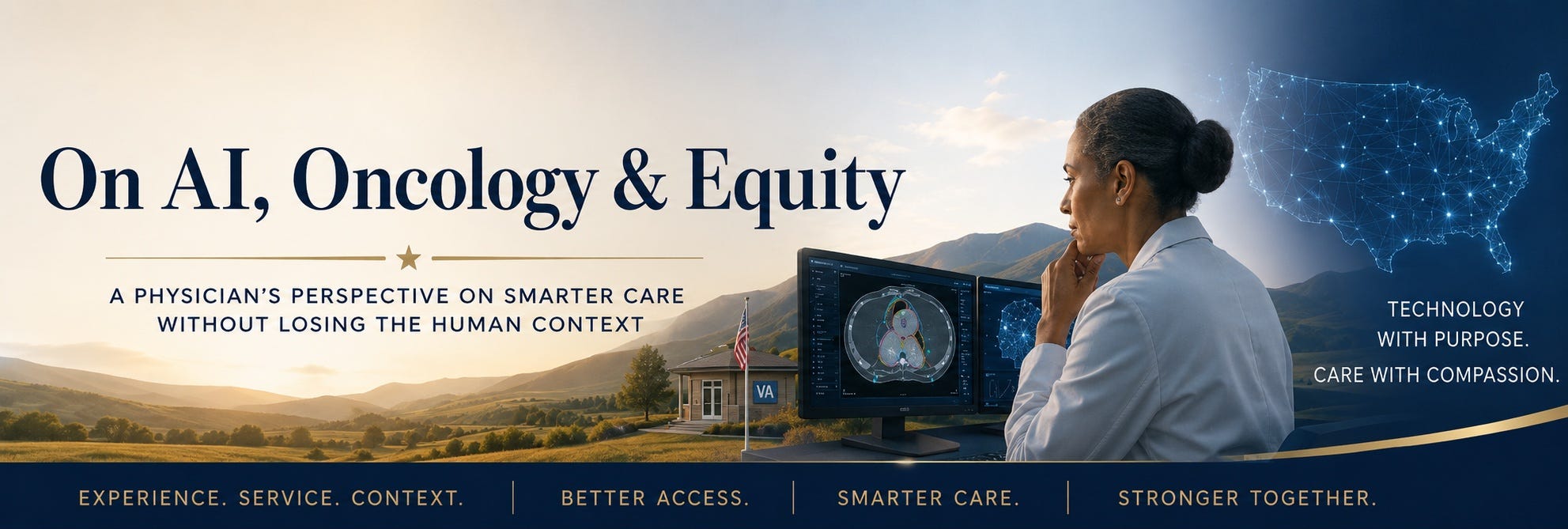
On AI, Oncology & Equity — A Physician’s Perspective on Smarter Care Without Losing the Human Context
Let me tell you what a rural radiation oncology shortage actually looks like from the inside.
Not the policy brief version. Not the workforce study footnote version.
I am a board-certified radiation oncologist. I am also a retired U.S. Army Lieutenant Colonel who began her military career as an enlisted Soldier. And I am a veteran — which means when I talk about what rural veterans face in accessing cancer care, I am not speaking from the outside looking in. I have been inside that system. I understand the culture, the language, the loyalty, and the particular frustration of a population that gave everything and is now navigating a VA system that cannot always meet them where they are.
That triple perspective — oncologist, veteran, VA advocate — is what I brought to the American College of Radiology (ACR) Annual Meeting in April 2024, and it is what I bring to this conversation now.
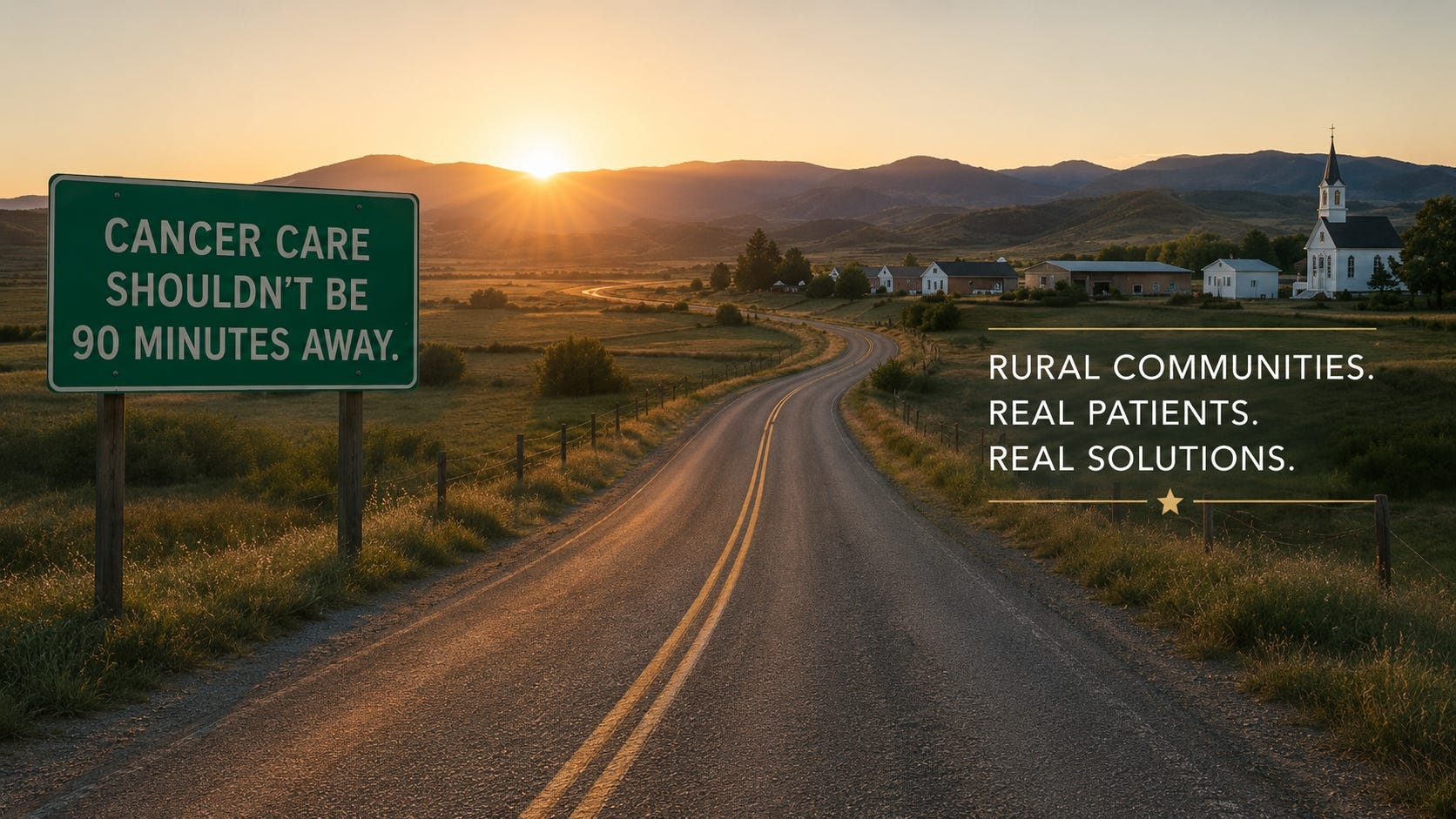
Here is what this shortage actually looks like: a patient who drives 90 minutes each way, five days a week, for six weeks, to receive radiation treatment — because the nearest clinic is the nearest clinic. A veteran who was told telehealth was available, but whose home internet cannot support a video call. A position posted for eighteen months with no viable candidate, and a community quietly, without announcement, losing access to cancer care.
In April 2024, I presented on exactly this at the American College of Radiology (ACR) Annual Meeting — a national platform where I laid out the case for how AI could augment the radiation oncology workforce in rural communities, address the broadband gap blocking veteran access to telehealth, and support remote clinical oversight in areas that simply cannot recruit a full-time physician. I was not speaking theoretically. I have opened two radiation oncology clinics — one academic, one private practice — and I have watched these gaps operate in real time, from the inside.
I share that context not to establish credentials, but to be clear about where this perspective comes from. This is not an AI enthusiast’s take on medicine. This is a physician’s take on AI — grounded in what the clinical reality actually looks like for the patients most at risk of falling through.
The Workforce Math Does Not Work
The ASTRO Workforce Study documented what many of us already knew: approximately 85–90% of radiation oncologists practice in metropolitan areas, leaving rural regions—home to about 15–20% of the U.S. population—relatively underserved. A substantial proportion of the current rural workforce is approaching retirement, with some surveys suggesting up to one-third plan to retire within the next decade.
We are not replacing them fast enough. Radiation oncology training programs are not geographically redistributing graduates into underserved communities at the rate needed. Financial incentives, professional isolation, quality of life concerns, and infrastructure gaps make rural practice a hard sell for newly trained physicians — however much we might wish otherwise.
This is not a pipeline failure alone. It is a distribution failure. And it has real consequences for real patients right now, not in some projected future.
What AI Can Actually Do
I want to be careful here, because this is where the conversation tends to go off the rails in one of two directions — either AI is going to solve everything, or AI is a threat to clinical standards. Neither is accurate.
At the ACR Annual Meeting, I walked through specific AI applications in radiation oncology — not as future possibilities, but as tools already operating in clinical settings. What follows is drawn from that presentation and from my ongoing work in this space. I offer it as a physician accounting for what I have actually seen, not what a vendor has promised.
Here is what AI can genuinely do for rural radiation oncology access today:
Automated contouring.
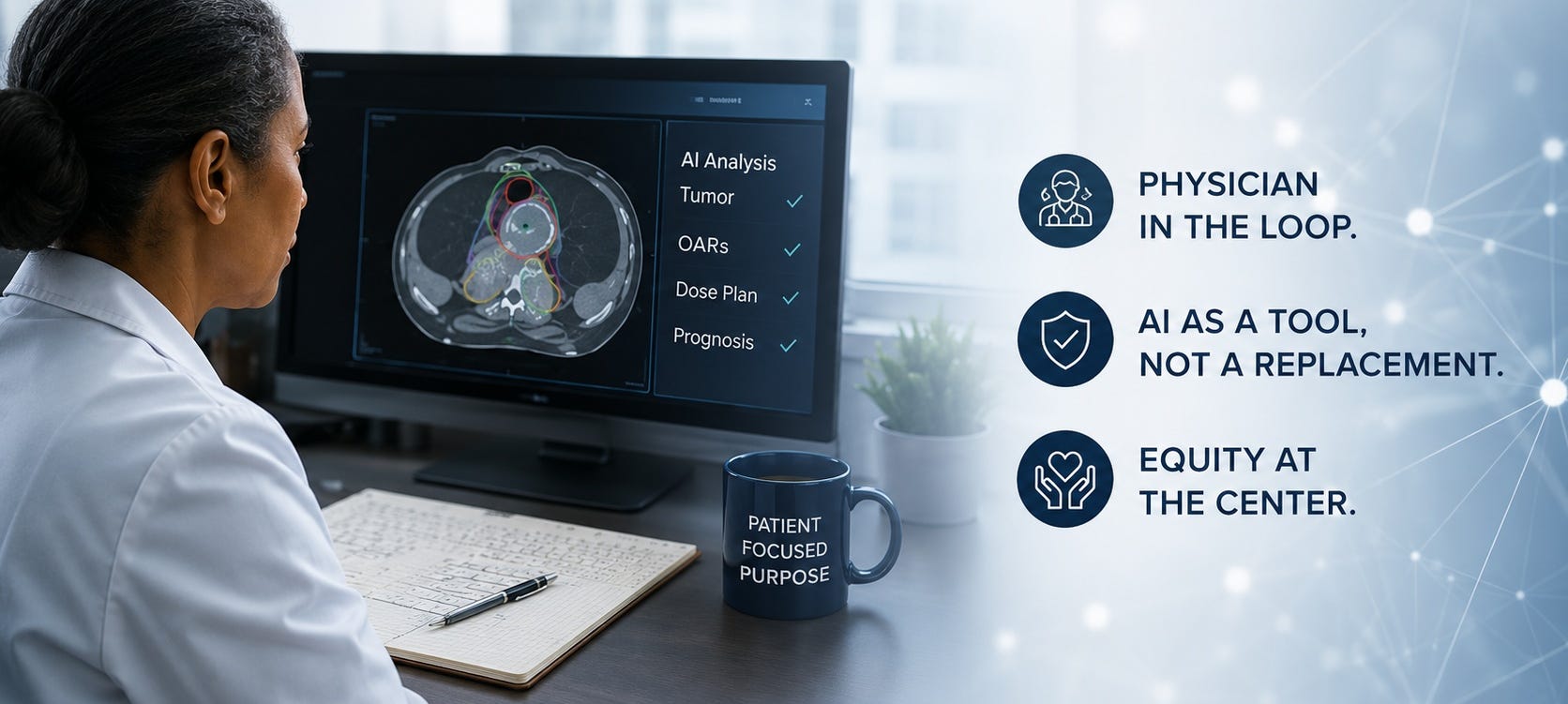
One of the most time-intensive tasks in radiation oncology is delineating — manually drawing — the boundaries of a tumor and surrounding critical structures on imaging. AI-assisted auto-contouring can reduce this from hours to minutes, enabling a single physician to support more patients across more sites without sacrificing accuracy. For rural clinics that rely on remote physician oversight, this is not a convenience. It is a capacity multiplier.
Adaptive radiation therapy support.
As a patient’s anatomy changes during treatment — which it does — the radiation plan needs to adjust. AI-assisted adaptive planning enables this to happen with greater speed and precision than manual replanning allows. This is particularly meaningful in settings where the physician is not physically present every day.
Remote treatment planning review.
A board-certified radiation oncologist can review and approve AI-assisted treatment plans from a distance. This model — already operating in various forms across health systems — allows clinical expertise to reach communities that cannot recruit a full-time physician. Done with appropriate protocols and oversight, it is not a compromise of care. It is an extension of it.
Quality assurance and error flagging.
The Radiation Oncology Incident Learning System’s (RO-ILS) analyses should give every clinician pause: RO-ILS have consistently shown that a significant proportion of errors are first detected by radiation therapists at the linear accelerator — at the machine, in real time. AI-assisted QA tools that flag anomalies before a plan reaches the patient add a layer of safety that is especially critical when fewer eyes are on each case.
What AI Cannot Fix
I want to be equally clear about the limits, because this is where honest conversation matters more than optimism.
AI cannot recruit a physician to a rural community. It cannot address the broadband gap that prevents 25–40% of rural and highly rural veterans from accessing VA telehealth from their own homes. It cannot resolve the financial and regulatory structures that make rural practice unsustainable for many physicians. And it cannot replace the clinical judgment that comes from a physician who knows the patient, has reviewed the full record, and is accountable for the decision.
I want you to sit with that 25–40% figure for a moment, because as a veteran I find it unacceptable in a way that goes beyond statistics. We ask men and women to serve in some of the most remote, resource-scarce environments on earth. We thank them for their service. And then we design a telehealth system that requires broadband internet — and are surprised when nearly half of rural veterans can’t access it from home. That is not a technology failure. That is a planning failure. And it is one that AI alone cannot fix, but that AI-assisted mobile care, remote consultation models, and community-based access points can meaningfully begin to address — if we commit to building them with the veteran’s actual situation in mind, not the ideal one.
The supervision question is real. During the COVID-19 pandemic, virtual supervision of radiation services was permitted — and in many cases, it worked. The subsequent push to revert to mandatory in-person supervision for all radiation services came from legitimate patient safety concerns. I respect that. But the question the field must sit with is this: what is the patient safety impact of no radiation oncologist at all? An ASTRO Town Hall meeting addressed some of these questions after virtual direct supervision was permitted — see video HERE.
For 2026, CMS permanently allows “direct supervision” in radiation oncology to be met via real-time, two-way audio and video telecommunications technology (excluding audio-only). This virtual direct supervision applies to both hospital outpatient departments and freestanding centers, provided the physician remains immediately available
For communities where the answer to that question is increasingly “that is our reality,” AI-assisted remote oversight — with rigorous protocols, documented accountability, and physician-in-the-loop at every critical decision point — is not a workaround. It is a model worth building seriously.
The Question I Keep Coming Back To
I am not an AI vendor. I am not a technologist. I am a radiation oncologist who has spent her career watching what happens when access is absent — in underserved communities, in rural clinics, in VA waiting rooms, and in cancer centers that serve patients who have already waited too long.
The question I keep coming back to is not “can AI do this?” The technology is capable of remarkable things. The question is: “will we deploy it with the patient who needs it most at the center of that decision?”
That is a human question. A leadership question. A values question.
AI is a tool. A powerful one. But tools do not make decisions about who deserves access to cancer care.
We do.
I am learning alongside this technology — asking the questions a physician needs to ask about what AI gets right, what it gets wrong, and who gets left out of the conversation. If your organization is navigating AI in oncology and wants a physician perspective in the room, I would welcome that conversation.
📩 Interested in a speaking engagement or consulting opportunity? [Click here to connect.]
And if this piece was useful — subscribe for more, published every other Friday under the AI & Medicine tab.
— Dr. C.M. Williams, M.D.
Board-Certified Radiation Oncologist | Retired U.S. Army LTC
Founder, Questions 4 Cancer Doctors (Q4CD)
Q4CD.com |
Thanks for reading Questions 4 Cancer Doctors! Subscribe for free to receive new posts and support my work.