

AI & Cancer Care Disparities: The Tools Exist. Will Health Systems Act?
The tools to close cancer care gaps already exist. The question is whether health systems will use AI, data, and physician leadership with intention.

On AI, Oncology & Equity — A Physician’s Perspective on Smarter Care Without Losing the Human Context
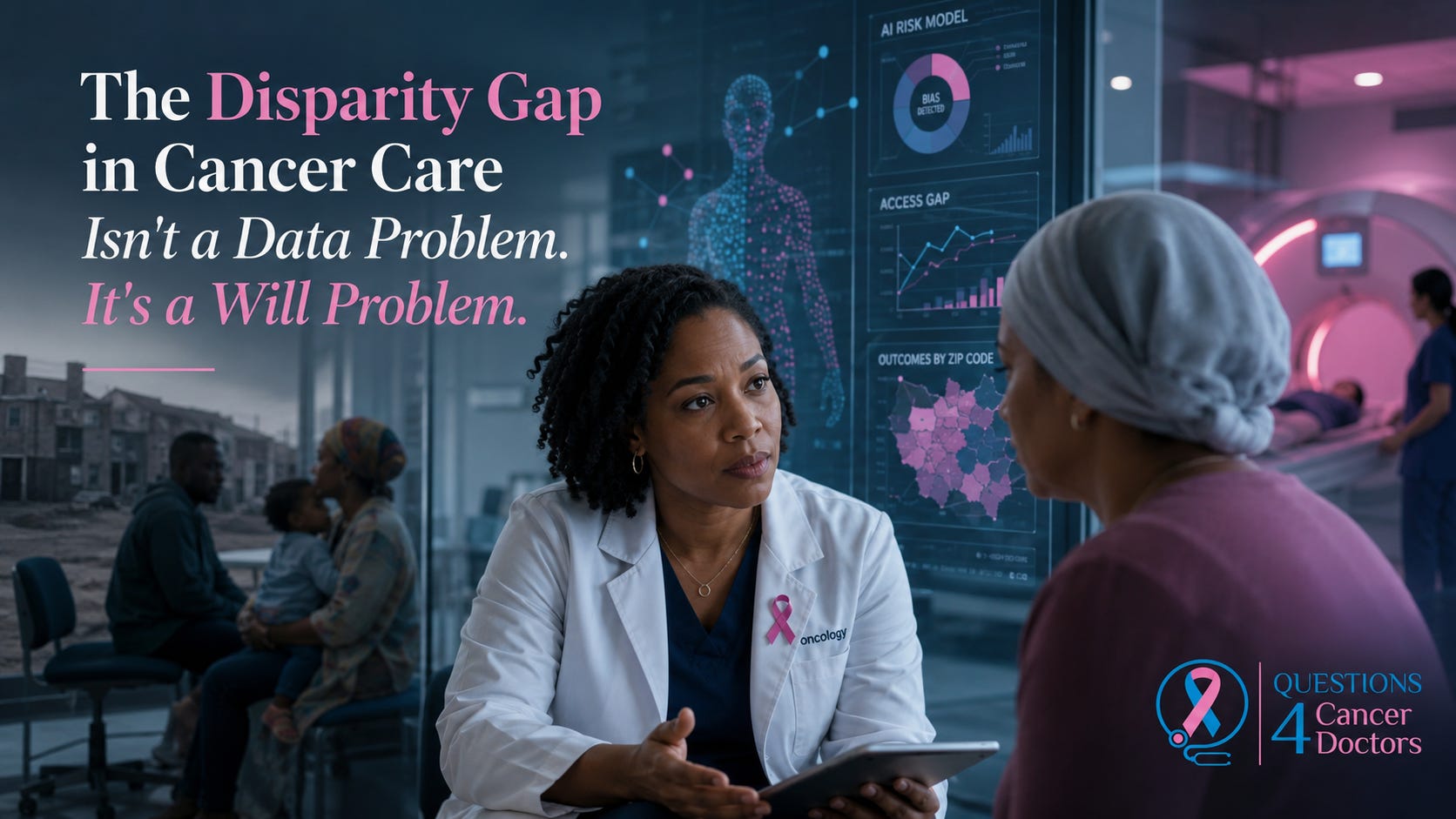
I want to start with a number, because I think numbers sometimes do what paragraphs cannot.
Black women are about 40% more likely to die from breast cancer than white women — even though incidence is not higher among Black women.
Not diagnosed more often. Not presenting with more aggressive disease at the same rate across all subtypes. Dying more often. From the same disease.
I have been a radiation oncologist for years. I have treated breast cancer patients. I know what guideline-concordant care looks like, and I know what it means when a patient doesn’t receive it. And when I look at that statistic, I do not see a biological mystery. I see a system that was not built with certain patients at the center — and the consequences of that failure, measured in lives.
Breast cancer is where the numbers are most visible in my field. But this disparity is not unique to oncology — it runs through heart disease, diabetes, maternal health, and nearly every major diagnosis. The fault lines are the same: race, income, geography, language. I speak to oncology because it is where I have spent my career. But make no mistake — we are describing a system-wide failure, not a disease-specific one.
I am a Black woman. I am an immigrant. I am Caribbean-born. Equity in medicine is not an abstract policy interest for me. It is personal in the way that only lived experience makes something personal. And it is professional in the way that only years of clinical practice can make you understand the distance between what the guidelines say and what a patient actually receives.
This piece is about that distance. And about what AI can — and cannot — do to close it.
If this resonates with you — subscribe for more physician perspectives on AI, oncology, and health equity, published every other Friday.
The Data We Already Have

The disparity in cancer outcomes is not a new discovery. We have known about it for decades. We have published on it, presented on it, convened task forces about it, and written it into strategic plans.
And the gaps persist.
Breast cancer is where the numbers are most visible — but the pattern holds across every cancer type where radiation plays a role: lung, prostate, colorectal, cervical. The gap between who receives guideline-concordant care and who does not follows the same fault lines regardless of diagnosis. Consider what the data shows:
Black women are about 40% more likely to die from breast cancer than white women — even though incidence is not higher among Black women
Lower-income patients are less likely to receive guideline-concordant cancer treatment
Rural patients often face longer travel times and greater barriers to radiation treatment centers — a real obstacle when treatment requires daily visits for multiple weeks
And for millions of people in the United States with limited English proficiency, the barrier is not distance or income — it is language. Informed consent conducted in a language a patient does not fully understand is not informed consent.
These are not gaps waiting for data. We have the data. What we have lacked — consistently, across decades — is the organized will to act on it at scale.
I say this not to assign blame, but to name the actual problem. Because if we misdiagnose the problem, we will keep proposing the wrong solutions.
Where AI Enters the Conversation
I have been asked, in various forms, whether AI will fix health disparities. My honest answer is: it depends entirely on how we deploy it.
AI is not neutral. It reflects the data it was trained on, the priorities of the organizations that built it, and the questions its designers thought to ask. If those inputs are shaped by the same structural biases that produced our current disparities — and many of them are — then AI will not close the gap. It will encode it, accelerate it, and make it harder to see because it will be buried inside an algorithm that feels objective.
If we misdiagnose the problem, we will keep proposing the wrong solutions.
We already have examples of this. Pulse oximeters — not AI, but a technology assumed to be universal — overestimate oxygen saturation in patients with darker skin tones. During the COVID-19 pandemic, this bias contributed to delayed recognition of hypoxia in Black patients. A cardiac risk algorithm widely used in clinical practice was found to systematically underestimate cardiovascular risk in Black patients. The bias was not visible on the surface. It was embedded in the training data and the assumptions behind the model.
AI in oncology is not immune to this. If predictive models for cancer risk are trained predominantly on data from populations that were historically over-represented in clinical research — which they were — then those models will perform less accurately for everyone else.
This is not a hypothetical future risk. It is a present reality that requires present action.
What Intentional Deployment Looks Like
Here is the distinction I want to draw carefully:
The problem is not AI…
The problem is AI deployed without equity as a design principle.
When equity is built in from the start — not added as an afterthought — AI becomes one of the most powerful tools we have for addressing disparity at scale.
Predictive analytics for screening gaps.
AI can analyze claims data, demographic information, and social determinants of health to identify members who are overdue for
cancer screening and unlikely to self-initiate. Some health systems are already using these tools to identify patients at risk of food insecurity and other care barriers — enabling proactive outreach before those patients miss treatment. That is not theoretical. That is working now.
Natural language processing for communication barriers.
After-visit summaries translated in real time into a patient’s preferred language, adjusted to their health literacy level, with automated follow-up prompts when the next appointment hasn’t been scheduled. Early NLP-assisted communication tools and related interventions show promise for improving follow-up and care coordination. For a population where language has historically been the reason someone didn’t understand what they were supposed to do next — this matters.
Social determinants screening at scale.
Food insecurity. Transportation gaps. Housing instability. These are not soft factors. They are predictors of treatment completion, and in oncology, treatment completion is a predictor of survival. AI tools embedded in care management platforms can screen for these factors, match patients to community resources, and alert navigators when a high-barrier patient goes silent. The technology to do this exists. The decision to build it into standard workflow does not yet exist in most organizations.
The Guardrail Conversation Nobody Wants to Have
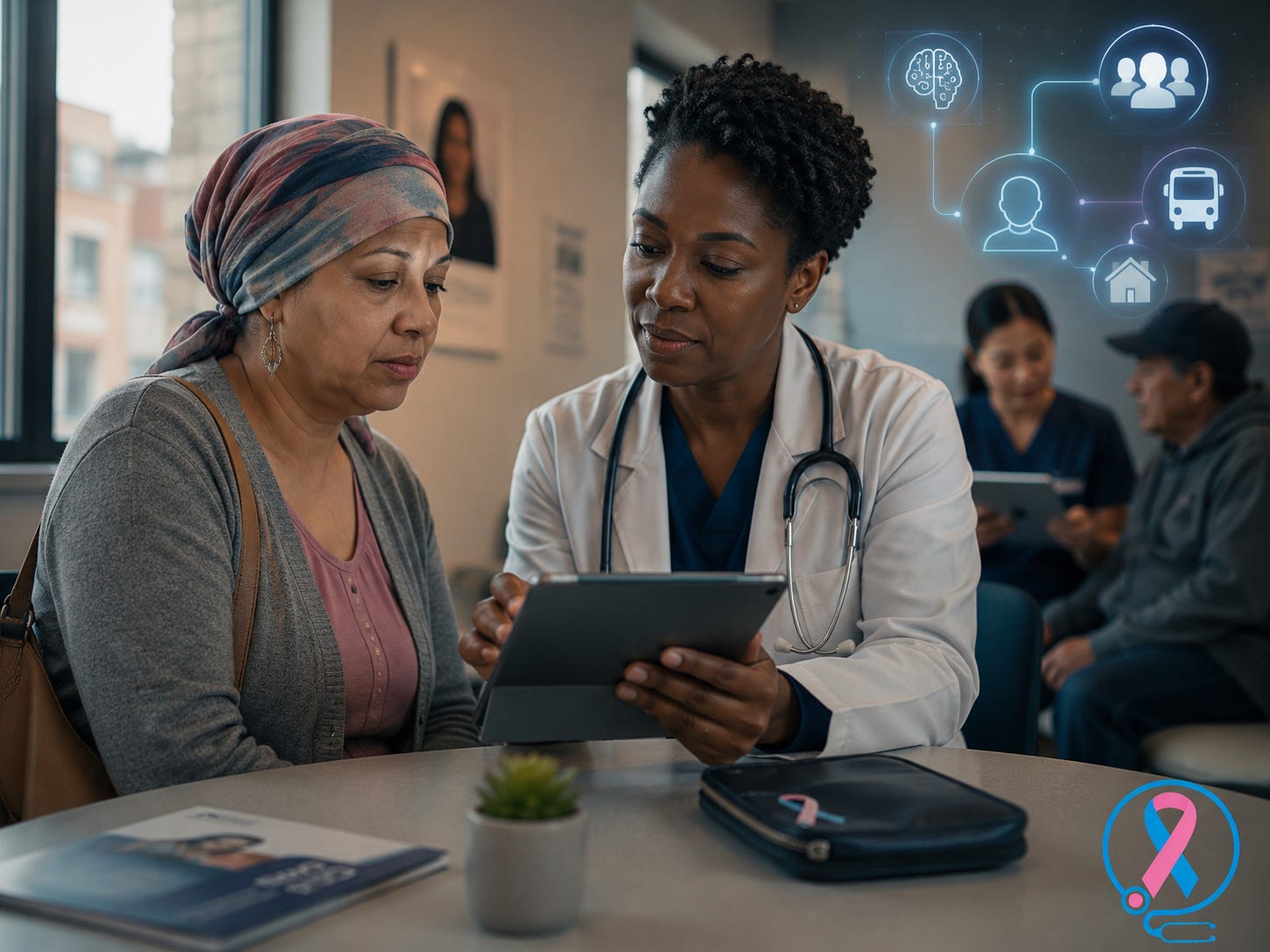
I want to be honest about the risk, because I think intellectual honesty is more useful than optimism.
AI deployed without diverse training data will produce biased outputs. AI that operates as a black box — where clinicians cannot see or explain its reasoning — erodes trust and creates accountability gaps. AI tools designed for smartphone interfaces exclude the patients who most need them, because digital access is itself inequitably distributed.
The patients who have the least access to guideline-concordant cancer care right now are the same patients most likely to be excluded from AI tools that weren’t designed with them in mind.
That is the equity paradox of AI in health care, and it requires us to ask hard questions before we deploy, not after.
What does your training data represent? Who was in the room when the model was designed? What happens to accuracy when the patient in front of you doesn’t look like the patient the algorithm was trained on? And who is accountable when the algorithm gets it wrong?
These are not questions that slow down progress. They are the questions that make progress worth having.
What I Believe
I believe the disparity gap in cancer care is closable. Not completely, not immediately, and not by technology alone — but meaningfully, measurably, within the professional lifetimes of the clinicians reading this.
I believe AI is one of the most powerful tools we have for closing it — if we build equity in from the start, require explainability and auditability, pair digital tools with analog outreach for patients without digital access, and keep physicians in the loop at every clinical decision point.
And I believe that the primary obstacle is not technical. It is organizational. It is the gap between knowing what the data shows and deciding — at the institutional level, at the payer level, at the health system level — that closing this gap is a priority worth resourcing.
We have had the data for decades.
The question has always been - the will.
I am a physician in the learning process on AI — asking the questions that clinical practice makes necessary, not claiming expertise I don’t have. If your organization is asking these questions too and wants a physician at the table, I’d welcome that conversation
📩 Interested in a speaking engagement or consulting opportunity? [Click here to connect.]
And if this piece was useful — subscribe for more, published ~every other Friday under the AI & Medicine tab.
— Dr. C.M. Williams, M.D.
Board-Certified Radiation Oncologist | Retired U.S. Army LTC
Founder, Questions 4 Cancer Doctors (Q4CD)
Q4CD.com |